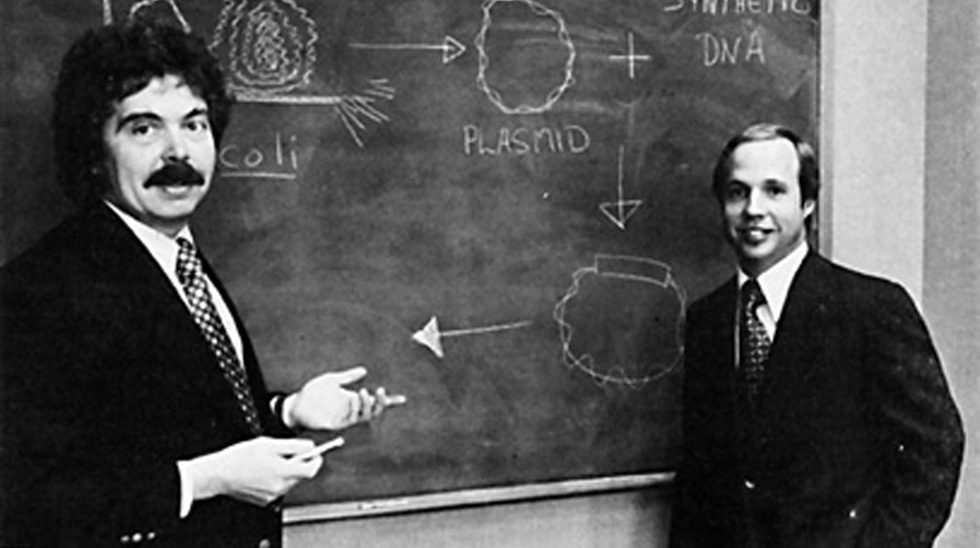

![]() Robert A. Swanson 1947 - 1999 |
|
![]() Herbert W. Boyer, Ph.D. |
|
Robert Swanson co-founded the Genentech in 1976 with Dr. Herbert Boyer, a biochemist at the University of California at San Francisco. Swanson, then a 29-year-old venture capitalist, approached Boyer about the possibility of developing biotechnology and marketing useful products using recombinant DNA technology. Swanson served as a director and as chief executive officer of Genentech until February 1990 when he was named chairman of the board, a position he held until his retirement in December 1996. Swanson passed away in December 1999. Although significant advancements were being made in the area of molecular biology in the 1970s, industry had yet to recognize the potential application of the new biologically-based technology to create beneficial new products. Under Swanson's guidance, Genentech provided broad applications of this science to modern society, developing new products such as human insulin, interferons, human growth hormone and thrombolytic agents. Prior to forming Genentech, Swanson was a partner with Kleiner & Perkins venture capital partnership in San Francisco, and from 1970 to 1974, he was an investment officer with Citicorp Venture Capital Ltd. Upon retiring from Genentech, Swanson formed K&E Management, a private investment management firm. Swanson also served as chairman of the Board of Directors of Tularik, Inc., a biotechnology firm focused on therapeutics that act through the regulation of gene expression. Swanson earned a Bachelor of Science in Chemistry from the Massachusetts Institute of Technology (MIT) and a Master of Science in Management from MIT's Sloan School of Management. Swanson was an active alumnus of MIT and was a founding board member of the MIT Entrepreneurship Center. Swanson was a member of the Overseers' Visiting Committee of the Harvard Medical School and served on the Board of Fellows of the Faculty of Medicine at Harvard University. He was also appointed to the Royal Swedish Academy of Engineering Sciences. Swanson contributed to numerous civic and cultural activities including serving as a trustee of the San Francisco Ballet, the Museum of Contemporary Art, the San Jose Tech Center, and as chairman of the board of Nueva School. Swanson died on December 6, 1999 at the age of 52. Please see the MIT Memorial for Robert A. Swanson. |
|
Herbert W. Boyer has served as a director of Genentech since he co-founded the company in 1976 with Robert A. Swanson, a venture capitalist. He also was a vice president of the company from 1976 to 1990. A biochemist and genetic engineer, Boyer first demonstrated the usefulness of recombinant DNA technology to produce commercial medicines, which laid the groundwork for Genentech's development. In addition to his role at Genentech, Boyer was a professor at the University of California, San Francisco and an investigator for the Howard Hughes Medical Institute. At the time Genentech was formed, Boyer was a professor of biochemistry and biophysics at UCSF as well as the director of the graduate program in genetics. He has taught in the microbiology department as well. In 1993, Boyer was awarded the prestigious Swiss Helmut Horten Research Award, along with Dr. Stanley Cohen of Stanford University, for their pioneering use of research in the use of gene technology in medicine. Boyer is an elected member of the National Academy of Sciences and in 1985 he was elected to the California Inventor's Hall of Fame. Boyer received the Golden Plate Award from the American Academy of Achievement in 1981 and the Albert Lasker Basic Medical Research Award in 1980. He is a Fellow in the American Academy of Arts and Sciences and received the Industrial Research Institute Achievement Award in 1982. Boyer serves on the editorial boards of several scientific publications and has written or co-written more than 100 scientific articles. Boyer received his Bachelor of Science in biology and chemistry in 1958 from St. Vincent College in Pennsylvania. He received his Master of Science and Ph.D. in 1960 and 1963 respectively, from the University of Pittsburgh. |

